Science in the City

Jul 9, 2021

3 Time Management Hacks For Teachers

3 Time Management Hacks For Teachers

                                                        Photo by JESHOOTS.com from Pexels


Teaching can be quite a challenging task if you're not prepared. You need to ensure that you are well prepared to go ahead and give the best to your students. This will require adequate planning from your end. as well as an investment of both time and resources.

Taking the time to prepare your lessons will require that you understand the needs of your students. This will ensure that you can give them the best lessons possible, whether on quadratic equations or civic Australia. In return, your students will comprehend what you are teaching and fully participate in your classes.

What Time Management Hacks Can You Use In Teaching

Good teaching is more than just passion and talent. Proper planning and time management are essential so that students can be given the attention they require. Good teachers have to stay tuned with educational standards while ensuring that their students are engaged and understanding the content. 

This will require keeping the students involved by making their lessons engaging and fun, challenging the students to think creatively, and encouraging students to actively participate in the lessons. As a result, learning will be more fun for them. Here are three time management hacks that teachers can use.

Action Plan

Your students look up to you, and you can't afford to fail them. You need to understand their needs well enough since this will help you in formulating an action plan. You can't afford to go with the flow since they are unique.

Your action plan should describe what your lessons entail and how they will be delivered. Allocate the amount of time that you will require to accomplish this. You can then time yourself to ensure that you stick with the plan.

This is important because it can be very easy to get drawn into trying to make a perfect lesson plan, or lose hours searching online for better ideas.  Limit your time, focus your efforts, and stick with the plan.  Allocate a certain amount of time and then stick to that. 

Have specific times set aside to go through your emails

There is a lot of valuable information that comes through emails, as well as some things that are time-sensitive. However, if you are teaching, or working on lesson plans, or doing something that needs your attention, it can be very disruptive to constantly stop for every notification.   There is nothing wrong with closing your email or turning off your notifications for an hour to two to focus and utilize your time better to complete a specific task. 

Achievable Deadlines

Give yourself deadlines when it comes to executing your duties. Whether it is going through assignments or planning lessons, have specific deadlines in ensuring that you get them done.  You can also use task managers or to-do lists to help with this. My personal favorite is Todoist because I can quickly and easily enter tasks and access them from any platform. If you are interested, here is a link to check it out

How Does Time Management Make A Teacher Qualified

Most schools face a similar challenge when it comes to getting teachers who can manage their time effectively. If time isn't well organized, the students will be the ones who will pay the ultimate price. They will not be able to cover their lessons or return graded work in a timely fashion which will affect student success and movement from one grade to the next.

However, when a teacher is skilled in managing their time, they will ensure that they allocate proper and sufficient time to their lessons. They will find a way to ensure that the syllabus is completed during the school year. They will do this with a lot of ease. They become an asset to the school because of their impeccable time management skills.

What are your best time management tips? What have you found worked well for you, or where do you struggle? Feel free to leave a comment. 

Jun 9, 2021

Helping Your Students Adapt To Online Learning

With such a huge increase in online learning, students are finding it more difficult than ever to cope. A large change in the style of learning is tricky to deal with, as most pupils are used to having a type of support from their teachers that is hard to achieve in a virtual classroom. Helping your students adapt to online learning will benefit their education dramatically, and it couldn't be easier to get started today. So, if you would like to find out more, then read on to uncover some brilliant tips that you can utilize today to show your students how to make the most of online learning now! 


Image Source - Pexels 


Make Yourself Available


One of the most important things that you must always remember when attempting to support your students through online learning is to make yourself available. You can have set times to respond to messages or emails, and set office hours on Zoom, but it is important that your students know how to reach you, and know that they will get a response. Having to work remotely can make it difficult for you to 'be there' for your pupils, as you can't physically stand by their side and talk through any issues they may have. Ensuring that you offer some kind of virtual replacement in the form of an email address or messaging service is essential, as this way your students will be able to get in touch with you at any time. Some kids may struggle when speaking in front of the class which might be the only option when performing an online lesson, so having the choice to virtually step to one side and speak in private (such as via email, messaging, or a Zoom breakout room) can be a real benefit. 


Adapt Your Teaching Style


As the style of learning has changed, so should your teaching. Attempting to follow your old work plan will make things far more complicated than it needs to be. It's going to be much easier to start again with a new way of thinking. Virtual learning requires a different approach, so it's a good idea to perform some research on useful platforms such as an edtech blog for K-12 teachers and administrators or an online learning center that you can use for inspiration. Some schools have been using virtual classrooms well before the pandemic struck, so it's a good idea to look to them in order to learn from past mistakes to avoid encountering any bumps along the way. 


Relieve Some Pressure


Though of course your students must still meet reasonable deadlines, you should aim to relieve a little pressure when performing virtual learning. There are many struggles that a child can face when attempting to learn from home, from an increase in distractions to a lack of support, so it's vital that you don't maintain the same high expectations as you would in any normal school environment. Be lenient, or flexible, when necessary, and always listen to what your students have to say - their issues could be justified, so it's important that you give them the opportunity to shine in their own time. 


Helping your students adapt to online learning has never been so simple when you can take the time to utilize the brilliant tips and tricks detailed above.


Apr 2, 2021

The More Organized You Are, The More Your Students Benefit

picture of desks and organized classroom

 Unsplash - CC0 License


As teachers, we spend a lot of our time thinking about the needs of our students. After all, it’s our job to make sure that they receive the style of learning best suited to them. We don’t want children left behind. 


But it turns out that we can help students the most when we focus on improving ourselves - how we do our job. Yes - we all know our subjects inside out. But many of us are lacking in the organization department. And that’s slowing us down, draining our energy, and making us less available to students.


In this post, therefore, we take a look at some of the strategies that you can use to improve how you spend your time and deliver lessons. Here are some of the steps that work for all teachers. 


Add Bins And Buckets To The Classroom


Organizing for one child is a challenge. But when you have thirty in a classroom, it’s a nightmare. 


The solution here for many teachers is to use labeled buckets and bins, arranged on racks. Storage containers allow you to neatly tidy away all of your learning tools and implements, without them cluttering up the classroom or storage cupboards.


How you arrange this is very much up to you. Usually, you can think of overall categories that allow you to make the best use of your available space.


Create Paper Routines


Classrooms have a habit of generating vast quantities of papers. Teachers have papers for teacher reports, students have them for graded tests and homework assignments. And you may even have papers for lesson plans. 


Here’s an idea: create a routine for all your papers by placing them in specific trays. One tray is for tests, another for student work, and another for staff documents you’re working on right now. This way, you can prevent them from getting muddled up and see how much work you need to do before your various deadlines. 


Keep Your Notebook With You At All Times


We can’t emphasize this point enough: keep your notebook with you at all times. It’s critical because it allows you to jot down ideas and record information on the fly, instead of trying to recall it from memory later. 


Sites like https://nottai.com/ show some examples of the types of notebooks that teachers use. Yes - they’re colorful. But they also include handy dividers that allow you to segment information logically. 


Keep Your Lists Nearby


You can either use a notebook for this or a separate piece of paper. But always make sure that you keep your lists nearby. Most people keep their lists next to their computers or desk, according to https://www.mindtools.com.  This way, you always have a record of what you’ve done so far, and what you still need to do. 


Make Sure That Every Item In The Classroom Has A Home


Lastly, you’ll need to ensure that there’s a place for every learning tool in your classroom and that your students know where they are. If things don’t have a home, clutter will quickly build up. 


What are your organization tips? Please comment below and share your best classroom tips!


Sep 17, 2020

The Best Sources of Literature to Read in Science Class

Encouraging students to read is such an important piece of education, at all grade levels and ages, and across all subject areas. Even as a science teacher, and although I am obviously a huge proponent of hands-on engaging science activities, I still consider reading so important.  In fact, I have an entire section of literacy posts on my blog. 

As we face a school year where things are quite different than usual, and where we are changing our teaching methods in many ways. Part of that change, or many of us, maybe an increased need for relationship-building activities with our students. At the same time, we are feeling pressure to make sure that we cover the curriculum.

The Best Sources of Literature in Science Class


I would like to suggest that you add in reading some books, or sections of books with your students. Reading can be a great way to engage students, to build community, to build literacy skills, and to engage them, particularly at a time when many hands-on activities may be off-limits. 

There are many fantastic science books that can be used in any of the following ways (and more):

  • Used in an English class to supplement your science lessons

  • Used as an enrichment activity

  • Used as a more engaging resource than a textbook

  • Used as an engagement hook at the start

  • Used as a way to see applications and wrap up a topic

  • Used as a tool to build vocabulary

You do not have to use the entire book or a long book. It is easy to use a chapter or a short story.  This can ensure that students start out on the same page, with a common experience. At this time when we are more divided than ever, it is important to create a place for students to connect. It’s even better if we can connect to our classroom and our lessons. 

These books will allow us a chance to do both. Did you know that every year since 1973, the National Science Teacher's Association has published a list of Outstanding Science Trade Books for students grades K-12 (Prior to 2002 the lists are only grades K-8).   Some years they even linked suggested activities. 

I hope you find this useful and fun.  I think your students will really enjoy this addition to the class. If you do use any of these resources, I would love to for you comment below with what resource you used, and how you used it.


Sep 3, 2020

The Lifestyle Changes You Can Make After Lockdown

When it comes to our lifestyle there is no denying that lockdown may have had us question some of our processes and the habits we have. As teachers, we are taking on new roles in the classroom, and approaching our jobs in ways that many of us never have before. However, we may also want to re-evaluate and approach some things differently in our personal life, or in our work-life balance.

With time to think things through, did you decide to make some changes? The truth is, we may have come out of lockdown wanting to make some positive changes, but where to start? Here are some of the lifestyle changes that you could make apart from eating well and exercising. 


The Lifestyle Changes You Can Make After Lockdown


Image source - pixabay - cco license 


Take better care of yourself


One of the first things that you could do would be to take better care of yourself. This means booking those dental appointments, regular check-ups at doctors for blood pressure and tests, and even the eye appointment you have likely been putting off. If you need glasses there are some great frames online and they can help you in different ways of your life such as reading or long distance. Taking good care of yourself means that you will be at optimum health in all areas of your life. Leaving you time to focus on the other changes you want to make.  This is not the time to skip these things. If anything we should realize that our health is top priority!


Get more sleep


There is no hiding from the fact that so many of us would like a little more sleep in our lives. Of course, you can do the obvious thing that would mean going to bed a little earlier, but is it really going to be the right thing for you? Instead, why not focus on getting a better quality of sleep. That means developing a bedtime routine just for you. Shutting off the technology at least an hour before bed. Relaxing in a warm bath and drinking a warm drink instead of something alcoholic or caffeinated. Getting better sleep can drastically change your mood and energy levels, which ultimately could have a positive effect on other aspects of your life. 


Say yes more


Could you say yes more? Are you one of those people who are afraid of stepping out of your comfort zone or taking that leap of faith? If this sounds like you then maybe a good approach to the year would be to say yes more. Yes to that night out. Yes to that night in. Yes to a holiday, or yes to more responsibility at work. Yes, yes, yes. Of course, Don’t do things that feel forced. But if it is a situation that you think you may regret it if you don’t say yes have the courage to just do it. 


Know when to say no


Finally, on the opposite end of the scale, you have people who just can’t say no. They say yes if it means inconveniencing them and they don’t want to do it. They say yes when they don’t want to do something. So a good lifestyle change for you would be to decide whether you should in some cases be saying no. Think about yourself and your family instead of others. It could really change the way you approach life. 


Let’s hope that some of these options have you considering other ways to take on the year ahead. 


What changes are you thinking of making, particularly as we head back into the school year?


Aug 20, 2020

How to Download Google Drive Files in Multiple Formats

We all have probably heard a lot about Google Drive by now, but what if you are a Microsoft school?  Or what if you want to use a resource with less technology, or in a different format?  Are all these Google Drive resources useless to you?  NO!! In this post, I hope to detail how you can still use many of these resources.  


We all have probably heard a lot about Google Drive by now, but what if you are a Microsoft school?  Or what if you want to use a resource with less technology, or in a different format?  Are all these Google Drive resources useless to you?  NO!! In this post, I hope to detail how you can still use many of these resources.

Google Forms

First of all, Google Forms are basically exclusive to Google.  You cannot directly use Google Forms in another format.  HOWEVER, they still work well on mobile devices, embedded, or with a simple link, as a way to quickly collect responses.  So don’t let that stop you or deter you from using Google Forms. They work well on almost any device. 


Google Docs or Slides

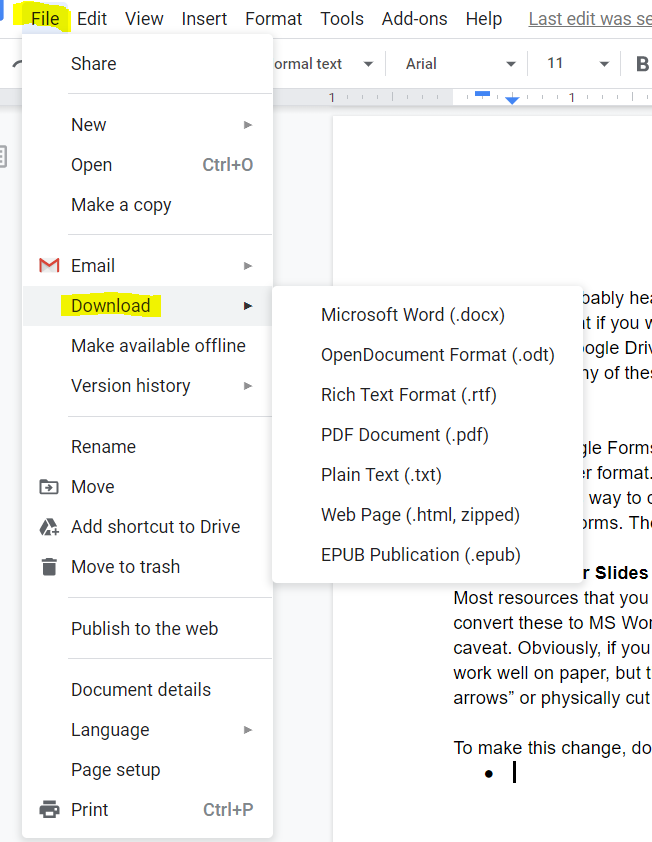
Most resources that you encounter will be in Google Docs or Slides format.   You can generally convert these to MS Word or PowerPoint in seconds.  You can also print to PDF, with one caveat. Obviously, if you have interactive features they will likely need some modification to work well on paper, but that may not be a big problem. It’s easy to add directions such as “draw arrows” or physically cut out the pieces.  


To make this change, use the steps in the following diagram: 


What are the various file formats? 

The two that will probably be the most useful and immediately recognizable are Microsoft Word and PDF.  However, there may be others in here that are useful to you as well.  I have found often people don’t know this menu is available. 


If you have further questions, additional comments, or examples of how you have used this, I would love to hear it!  Please leave a comment below, email me, or post in our Facebook group. 


I hope this makes some of the many Google Resources that are available even more useful and accessible to you and your students. 


Aug 6, 2020

Popular Q & A For Teaching Static Electricity

One of my most popular FREE resources is designed to teach about static electricity.  It is written for middle school but would be appropriate for upper elementary, or perhaps 9th grade.  


This middle school static lab is a lot of fun, and memorable for students. It includes an explanation, with diagrams, of static electricity, and then five stations of activities for students to explore static electricity. It also has summary questions for them to answer to process and assess their knowledge.  In this post I answer some common questions, and explain ways to extend this activity

This middle school static lab is a lot of fun, and memorable for students. It includes an explanation, with diagrams, of static electricity, and then five stations of activities for students to explore static electricity. It also has summary questions for them to answer to process and assess their knowledge.


It used very basic household materials, so it would also be an activity that you students could do at home, if needed, or to show their families what they have been learning.  The materials needed (to do all five stations) are: soda cans, inflated balloons, packing peanuts in a plastic bag, small pieces of wool cloth, puffed wheat cereal, black plastic strips 

Here are some common questions and answers that I often receive.  


  • Can you explain more about the materials?  What if I don’t have some of the materials? What can I use instead? 


Material

Possible Substitutions

Inflated balloons

Bubble wrap/bubble packing materials

Packing peanuts

Cut or break apart small pieces of a styrofoam cup or plate

Small pieces of wool cloth

Another cloth can be substituted.  Some types of cloth that work well would be something ‘furry’ or fuzzy, nylon, or even leather. 

Puffed wheat cereal

Could use another similar cereal that is not too sweet and is in discrete pieces, such as cheerios.  Something puffed may work better simply because it is so light.  Puffed rice cereal would also be great. You can also use black pepper here as well.  

Black plastic strips

You could also use a comb, small ruler, or another plastic strip.  If needed, you can substitute the balloon here as well. 

What classroom management tips do you have for doing this lab with middle school students? 

I have done this lab as stations, but it is easily adapted.  I wrote a more lengthy post about how to run stations that may be helpful. 

Further Inspiration and direction

In case you are looking for more inspiration or an engagement video to get your students started, it can be very engaging to do something very simple, that ties it back to real life.  Static electricity causes lightning, so it would be eye-catching to have a picture of lightning up on the board and ask students for their ideas about what causes lightning at the start of class.  


There are also many readily available pictures of children with their hair standing on end, etc.  Again, this could easily be used to capture student attention and engage them before starting the activity.


In either of these cases, it would be ideal to return to that picture after the lesson and see if students could further explain the cause of that phenomenon. 

Extensions

If you are looking to extend this further, this is the perfect lab to practice experimental design. Students can choose one variable to test (such as the type of fabric, or the type of cereal) and determine how it affects the results that they see.  This could even be a chance to graph some data if you can collect quantitative data.   


If you want to try this activity in your class, with complete written directions and summary questions, check it out here.


Jun 4, 2020

How Teachers Can Support Students Studying At Home


(Pixabay CC0)

At the time of writing, many children are studying at home due to school closures instigated by the COVID-19 pandemic. Many teachers are having to find new ways to support their students, and also their student's parents who have been encouraged to provide learning opportunities at home.

Of course, going beyond the pandemic situation, you might still find cause to support those pupils who have to study at home. There are instances when some children can't make it into school, for a variety of reasons, and there are reasons why schools might be closed too. We are thinking of the weather, for example, which can cause disruption for many.

When offering support then, you might want to consider the following suggestions.

Provide activities in a range of formats
You already know that children have a range of different learning styles, so try to vary the activities you send to them. Some children will benefit from recorded lessons that can be accessed online, whereas others might need to experience hands-on learning when under the tuition of their parents.

It's important to remember that children from low-income families might not have access to computers and smart devices, so paper-based activities should be provided when digital learning isn't possible. You will already have printables that can be used at home but click here for some literacy examples.

Thinking about your students then, consider their individual needs, and then try to match them when preparing activities for them to do at home.

Offer parents practical support
In a lot of cases, older children will need little support from their parents, other than the encouragement to actually buckle down and work. Younger children will need more support, so their parents will need to have some understanding of how to teach their youngsters effectively.

So, give parents clear guidance on what they need to do to support the needs of your students. Share activity ideas, give them instructions on how to deliver a lesson, and offer tips on time management. Remember that most parents won't have your expertise, so stay clear of jargon, simplify your instructions and share tips that can easily be adopted.

Be reachable too. While you don't want to inundated by calls from parents, you might still offer your services online. If your school has a Facebook group, make yourself available at certain times of the day, as you will then have the opportunity to support any parents who have questions or concerns about the lessons they are being asked to deliver.

Go live!
Skype and Zoom both offer group chat functions, so you will have the opportunity to connect with small groups of pupils at a time. Use these platforms to talk to your students, offer them encouragement and reassurance, and when its practical to do so, provide some level of teaching from behind your computer screen. This is also your opportunity to connect with parents, so encourage them too, and guide them if they need advice on any aspect of their children's learning.

Thanks for reading!

May 21, 2020

How to know if you are successful as a teacher

How to know if you are successful as a teacher

One of the down sides of teaching is that you may never feel like you have done enough. It can be overwhelming. Particularly now, when we are doing distance learning and transitioning to new methods of teaching, in many cases while taking on responsibilities at home with our own children, it may not feel like you are “doing a good job” or “being successful.”

First of all, there are answers, and no hard rules right now for what you should be doing. All bets are off. You are doing enough. You are doing your best to help your students and take care of yourself. You are doing it right.

So how do you measure success? Many of our common measures of teaching success are not fair to teachers (as well know), or only tell part of the story. For example, test scores. We all know about that. Many of these ‘measures’ are out of our control and influenced by so many other factors, that they are really not measuring teachers’ success at all. 

How to know if you are successful as a teacher

So how do you measure and evaluate your own success?

This question came up in our Facebook Group a while ago, and I would like to share some of those responses here, as well as add a few others that are specific to some of the more recent events.

From the Facebook Group

  • From member Louette McInnes: New teachers take note. When I started teaching, an experienced teacher told me that if I had 'one really great lesson a day', that was success. He also said it would take me a year to get one course set up so I knew it would be really successful and do what I wanted it to do. He was right.
  • Don’t compare yourself to others - look at your own progress, look at the interactions and progress that you can see with individual kids
  • Are kids respectful (for the most part), are they engaged? Are they learning?
  • Are they thinking?
  • What do they know that they weren’t able to do when they came to you?
  • And more in this post

In addition, right now, some things are more important than academics.

  • Are you building or maintaining relationships with your students (and their families)?
  • Are you working to meet your students needs (both academic and otherwise), while taking care of yourself?
  • Are you helping students to make some progress, within their other constraints?
  • Are you doing the best you can? Not giving up? Trying some creative ideas, even if they don’t all work? Taking some risks with the hope of improving?
Then you are successful as a teacher!

Keep building relationships, keep thinking, being creative, and building relationships with your students and the rest will come. Teaching is not a place for instant gratification. You won’t start your teaching career, or your school year, and have it all be successful. It’s a slower process. You will make gradual gains, and have ups and downs. But over the long haul, as you look back, you will absolutely see signs that you have been successful!!

May 7, 2020

Integrating Math and Science in the Classroom

It’s easy to focus on teaching just our curriculum. But often, in science class, we are expecting students to be able to use certain math skills but in actuality, their math skills may be a big source of struggle.

As teachers, there is always a balance between teaching students our content area, and following the curriculum, but also teaching students other core skills that they will need for our class or for others. I am often asked about how to integrate more math into science class. Here are five strategies that I have found to be helpful.


Five Strategies to Integrate Math into Science Class

  1. Talk to your math teachers; find common ground on how you are teaching the content. It is confusing to students if we are teaching the same or very similar concepts but using different language, or slightly different instructions. Pull out key math concepts that you need the kids to know and talk to your math teachers. Find out if they cover those topics. At what grade level, how do they already teach it? This might include things like graphing, solving a proportion, converting units, or basic algebraic equations. Kids have a hard enough time transferring skills between classes, or retaining what they learn and applying it outside of class. Any time we can put in working with the math teachers to come up with a common language and skill set will absolutely benefit both of us.
  2. Utilize opportunities to talk about number sense and practice if the answers make sense. Kids are often so stuck on doing the steps, and getting an answer, often using a calculator, that they don’t stop to think about their answer and consider if it makes sense. I like to put a stop to this, if possible, by starting the concept or math lesson with very easy numbers, and not letting them use a calculator. Keep the numbers SUPER easy so they build up some confidence and focus on the topic.
  3. When it gets too complicated, it’s ok to use a calculator. After they’ve gotten the idea, I think it’s ok to use a calculator. Many times, kids get frustrated and overwhelmed by the numbers. If, in fact, they will be able to use a calculator going forward, then I think it’s ok for them to use a calculator moving forward in the class, and they have an understanding, then allow them to focus on the concept.
  4. If there is a good climate for collaboration, take it one step further. Work with your math colleagues to use some of your data from science class for math. This can be done in many parts of math class, practicing graphing, data analysis, and more. Here is a great example Successful Math and Science Teacher Collaboration: The Administrator's Role
  5. Last, but absolutely not least, build up students’ math confidence. Many students can do the calculations, but they struggle to feel confident and to be comfortable applying their knowledge, particularly in a new situation. I cannot overstate how important it is for kids to feel comfortable. They will more willing to practice and take risks if they feel more comfortable.
I would love to hear if any of these tips help you, or what other suggestions you have to integrate math and science in your classroom. Feel free to comment below!

Dec 20, 2019

How to Streamline your Lesson Planning

How to Streamline your Lesson Planning

Reduce Lesson Planning Time

I would like to suggest a few things:
  • Start with a similar structure like a template not only for the lesson plan itself, but for your unit, so you know what sort of activity you're looking for to plug in there.  Here is a basic example, but obviously you would have to make it fit the structure that you prefer.
  • It also may help to know what type of activity you are looking for. Are you looking for something hands-on? What skills do you need to address? Are you looking for something technology based? Are you looking for a writing assignment? You may want a mixture of those skills and types of assignments throughout the year.  It can be very helpful to make a grid, or even a list of the different types of skills and activities. Then you can track when you have used them, or check them off as you use them.  This allows you to see which type of activity you haven’t done in a while, or what you want to utilize more of.  Again, then you know what you are looking for in your upcoming assignments. This can narrow your search, and be better than staring at a blank screen. 
  • It’s also a good idea to go back to your objectives and focus on what you're really trying to accomplish. What is the most important thing for students to know both in terms of skills and content?  How are you going to get this across in your lesson next? 
  • Once you have some of these things narrowed down, absolutely don't be afraid to look at what's already out there!  I think it’s better to get a clear idea before you just start looking though. It helps you more efficiently find something that fits your needs. You don't need to reinvent the wheel!  If it already exists, or something very similar already exists, by all means use it!!  It’s also ok to start with something and modify a little bit. Maybe there is something that’s a reading and writing activity but you decide to use the reading, and make the response in the form of a presentation, go for it!
  • These tips won’t take away your lesson planning, but perhaps will save you some time and make it a bit more efficient.

What are your tips and strategies to use your time more wisely when planning?


Dec 13, 2019

Why is it so important for teachers to have good time management skills?

Why is it so important for teachers to have good time management skills? 

I'm sure you already know some reasons, but I'm going to go a little bit different direction. It's extremely important for teachers to have good time management skills in order to protect their boundaries their own health and their families. Just today, another teacher said to me “you’ve got to find time to play, or this job will drive you crazy.” 

Manage your time so it doesn't manage you

In other words, manage your time, so it doesn’t manage you! 

One of the drawbacks of teaching is that the job is never done. There's always more you could be doing, so it's important to manage your time and manage your boundaries. You have to make sure that teaching and teaching-related tasks don't take over your life.  So, when I say manage your time, yes, I mean productivity tips and working efficiently, but I also mean that it's important to manage when you're going to work, how much time do you have to allow for work?  What tasks do you have to complete? And how are going to fit those tasks into that window of time?

Grading

For example, think about the amount of time that you are willing to spend on grading, in order to have some balance with your own life.  Don't assign more than you can read.  Set up the assignment in a way that will be easier to grade, such as making a rubric, have some peer review first, or grade only a portion of the questions.

Lesson Planning

Lesson planning….Yes, there are perfect ideal lesson plans that are engaging and inquiry-based and project-based, but it has to be a balance! It's okay to do some packaged lesson plans.  Maybe not every day, but sometimes it’s totally fine.  Sometimes you and the students both need an easier day!  Choose carefully about where decide to spend your time.  Make sure you are spending time on the things that are really valuable to you and your students.  There may be things that you are good at, or you enjoy doing, but and they won't really have a benefit to your students.  If you are doing them for fun, that’s ok, but don’t get confused between the two. Do you see a difference because of the work you put in on that task?  Is it a good use of your time?  For example, it's very easy to get sucked into formatting documents, changing weights of assignments and adjusting the layout on the page, but those are probably not an efficient use of your time.

A different mindset

Think of it this way.  If you worked at an office job, in many cases your boss would manage your time for you. They want you to be accountable for the time that you're at the office and they allow you a certain number of hours off.  They may even have billable time for certain projects, and a budget or limit of hours for those projects.  Teaching is a little bit different. You have to manage your own time. You are (in a way) Your Own Boss. So manage it accordingly!  Be the boss of your time1 Make sure that the time you're spending on the right things and would be reasonable if you were accountable to someone.

Nov 29, 2019

How to Motivate Students in the Classroom

How to Motivate Students in the Classroom

Why are they unmotivated? 

How to motivate students in the classroom is such a difficult topic!  So many students that I see are very disengaged for a variety of reasons.  These reasons are discussed in depth here, along with some methods to address various reasons.  However, there are some general statements that can be made as well.  In order to get them motivated, I think it is really important to find out what those reasons are.  There can be many varied reasons within one classroom. Are they disengaged because there's something going on with them outside of school?  How can they focus on academics when they're concerned about where they're going to sleep or where their next meal is coming from? Are they disengaged simply because they don't understand and they have not been successful in school in the past? Are they disengaged just because it's not their topic of interest? And there are probably as many more reasons as there are individual students. 

What to do about it?? 

Lots of Encouragement

So what can you do about that? It can be difficult to get students motivated, for sure!  Again it's important to be positive with students.  Don't assume that their behavior is coming from a negative place, or is directed negatively towards you.  Telling them something like "you're doing a great job," or "you're off to a good start, let's see if we can finish this up" or event "do you need help getting started?" can go a lot further. Also, helping them see the bigger picture and see the progress and successes that they are making is so important.  This alone be motivating. Constant encouragement that they can do it and that they will be able to have success will also be so important. 

Bigger Conversations

Having those bigger conversations, if the opportunity arises, with students about their goals, and  about not following blindly what their friends are doing is important. They may not have someone else in their life often talking to them about what they want (graduation? College?) and how those goals fit into what's happening today.  I have seen quite a few students who don't make the connection between what's happening today, and their longer term goals. 

Engaging Lessons?

Of course, you will hear recommendations to motivate students by making a lesson more engaging.While it is absolutely true making a lesson engaging and relevant to students is absolutely key, this is not the only way.  Doing something that gets their attention right away is so important but then we don't want them to lose that motivation the minute that it's not as engaging. 

I'm now working in a program with students who are recovering credits.  They are all behind on credits to be in the program.   In fact, much of their coursework is pre-packaged and is not particularly motivating or engaging all the time.  It has been interesting for me to look at what keeps them motivated.  For many students it's simply a desire to earn credits, to graduate, to be at the appropriate grade level, or to catch up to their peers. They are willing to do what they need to do.  It's been an interesting lesson in making engaging curriculum vs. other motivating factors. 

Our students are successful when they build positive relationships with the teachers, when they feel that they can be successful, and when they have some flexibility to get the help that they need. 

Ultimately I think the motivation has to come from within the students. If that means taking the time to do some mindset/reflection type of work, build relationships and work on things that are not content specific I think it will pay off.  There are other articles that have researched and had similar findings about student motivation. 


Nov 15, 2019

Two Resources I Want to Share with You

If you've been around here a while, you probably have been hearing me talk about two topics that have been on my mind a lot lately.  Namely, teacher self-care and balance with the rest of your life, and giving teens role models of other teen scientists.

If you've been around here a while, you probably have been hearing me talk about two topics that have been on my mind a lot lately.  Namely, teacher self-care and balance with the rest of your life, and giving teens role models of other teen scientists. As I have been digging into these topics I came across two resources that I want to share.
Add caption


As I have been digging into these topics I came across two resources that I want to share:

1) Angela Watson is the author of the 40 Hour Work Week Program (which I have not done), the Truth for Teachers Podcast (which I love), and many other teacher resources.  Her newest resource is this book.

She describes herself as "productivity and mindset specialist, author, and motivational speaker for educators" and that she believes in "challenging the narrative of the overworked and unappreciated “super teacher.”

This book does a great job of that.  She is not teaching time management and productivity tips, but really addressing the underlying issues, both systemic and individual mindset to help us view our jobs and manage teacher stress and constantly increasing demands in a healthier way.


2) As you know I have been working on creating resources about meaningful examples of teen scientists.  In doing this work I have been lucky enough to correspond with a few of them.  One was Stella Bowles.  If you aren't familiar with Stella, here is a link to her website.  I am working on a differentiated reading comprehension passage about her now.  However, in talking with her, I found out that among her other amazing work, she has written a book!  The book is geared toward middle or high school students. It is currently in the classrooms of all the schools in the Canadian province where she lives, but she is looking to get it into more classrooms, including here in the US.  I think this would be a fantastic cross-disciplinary project, or even a book to read in class.  

It is both a great read, and yet another example of a teen really making a difference!  


If you end up checking either of these out, I'd love to hear your feedback! 

(note: affiliate links)
Related Posts Plugin for WordPress, Blogger...