We all have probably heard a lot about Google Drive by now, but what if you are a Microsoft school? Or what if you want to use a resource with less technology, or in a different format? Are all these Google Drive resources useless to you? NO!! In this post, I hope to detail how you can still use many of these resources.
Google Forms
First of all, Google Forms are basically exclusive to Google. You cannot directly use Google Forms in another format. HOWEVER, they still work well on mobile devices, embedded, or with a simple link, as a way to quickly collect responses. So don’t let that stop you or deter you from using Google Forms. They work well on almost any device.
Google Docs or Slides
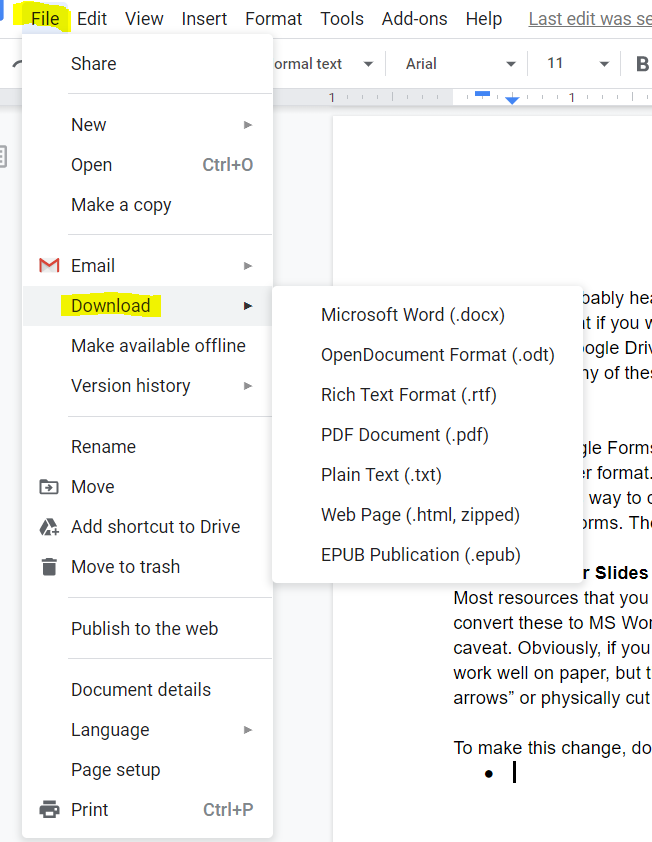
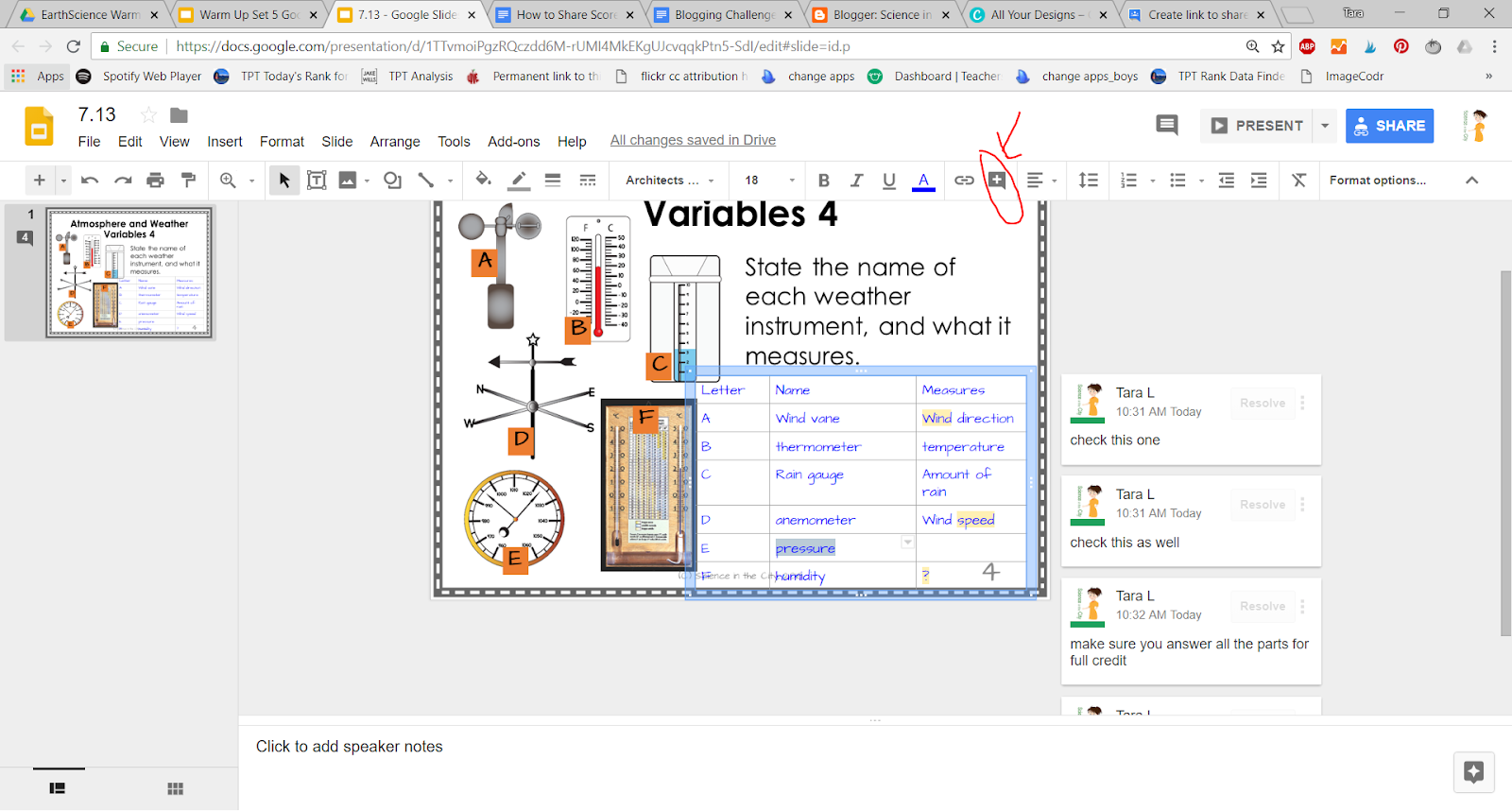
Most resources that you encounter will be in Google Docs or Slides format. You can generally convert these to MS Word or PowerPoint in seconds. You can also print to PDF, with one caveat. Obviously, if you have interactive features they will likely need some modification to work well on paper, but that may not be a big problem. It’s easy to add directions such as “draw arrows” or physically cut out the pieces.
To make this change, use the steps in the following diagram:
What are the various file formats?
The two that will probably be the most useful and immediately recognizable are Microsoft Word and PDF. However, there may be others in here that are useful to you as well. I have found often people don’t know this menu is available.
If you have further questions, additional comments, or examples of how you have used this, I would love to hear it! Please leave a comment below, email me, or post in our Facebook group.
I hope this makes some of the many Google Resources that are available even more useful and accessible to you and your students.
I don't know how long your commute is but one of the things that I really like to use my commute time for is to listen to podcast or audio books. What podcast do I recommend? It depends upon how you want to use your time. There are several great options!
Escape Reality
Sometimes I enjoy podcasts that are audiobooks or story and give you an escape. They are just fun and make you energized and uplifted. That's completely fine! Some of my favorites in this category are:
Six Minutes (appropriate if you have middle-grade kids with you)
Professional Development
There are also educational podcasts if you want to get some professional development time while you are driving. Some of my favorite educational podcast are:
If you're looking for podcasts that are not just teaching related, but still allow some room for growth and learning, of course, it will depend on your interests. There are podcasts on almost every topic under the sun! However, two in particular that I think might appeal to a lot of people are:
Besides podcasts, other great ways to use your commute time include audiobooks (available for free through your library on the OverDrive App, Hoopla, or sometimes other options depending upon your library). You can always listen to music that will get you energized during the day or put you in a good mood.
Connection
If you have Bluetooth in your car, or a good hands-free setup, this is also a great time to catch up with family or friends and make a quick phone call for connection.
Bonus - Quiet Solitude and Recharge!
Additionally, depending upon your personality, if you feel like you've been talking to people all day and you need a break, then absolutely use this as a time for peace and quiet! It's perfectly fine to turn the radio off. Just enjoy the time to yourself in the car so that you come home calm and ready to face your family and the rest of your day
Some of you may need some peace and quiet some of you need a chance to interact or tune in to something else. You know yourself best, but don’t waste that time! Use it to your advantage! It can help you in one way or the other throughout the day.
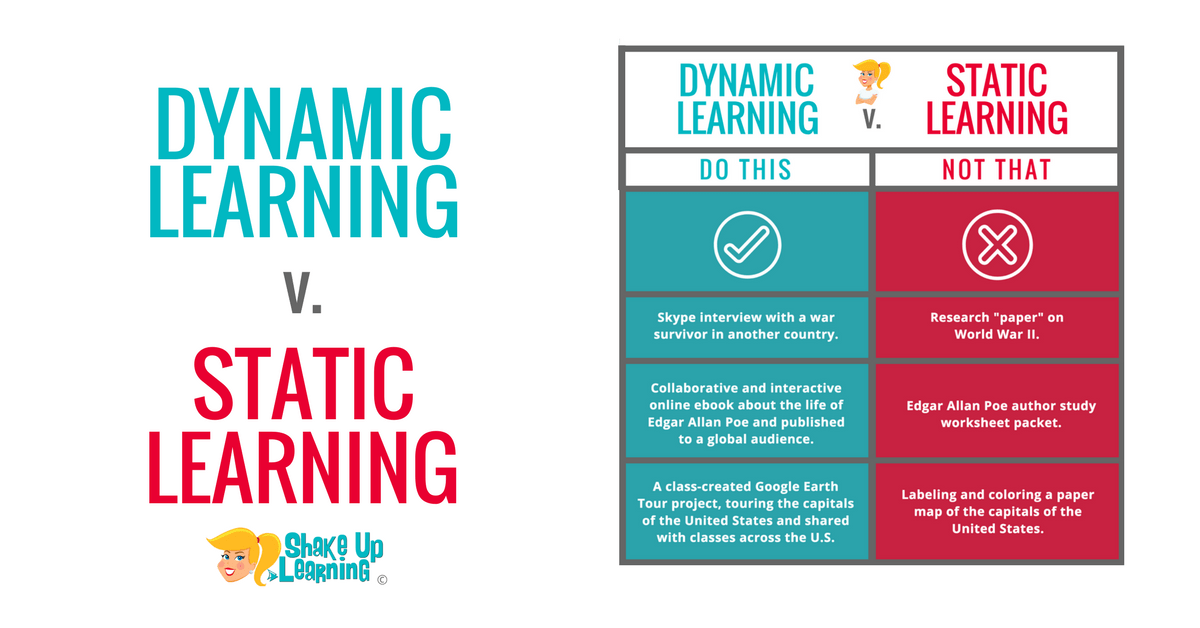
What is Superior about Dynamic Learning? #shakeuplearning
Shake up learning calls for learning activities that go beyond one and done activities. Learning can (and perhaps should) break the boundaries of the school day, due dates, and the prescribed curriculum.
This new style of learning and teaching involves the following:
Risk-taking
It is important to model risk-taking and teach students to face their fears.
FAIL = first attempt in learning
This can be taught through modeling, explicit teaching, and asking questions that don’t have just one right answer.
This can also be reinforced through teaching about famous failures, and those who have overcome a difficulty.
Breaking barriers and bad habits
Real learning can happen anywhere, anytime, and is driven by interests and curiosity
Real learning is not one size fits all
Grades should represent understanding and learning, not compliance
Always learning
Learning can happen at a variety of times and places, not only in a traditional lesson in the classroom.
This involves teaching students how to find answers on their own
How to curate resources
How to search effectively
Troubleshooting. When students have difficulty finding something, or you have difficulty with a resource, use this as a teachable moment!
Learning can be a la carte and publicly available - Pinterest, Instagram, Facebook groups, etc
Sharing your voice/connect
Don’t be afraid to share your thoughts and your work, as well as your students’ work. This doesn’t mean that you are claiming to be an expert but is a reflection of your learning and your talents.
Share through Social media, Twitter, blogs and develop a personal learning network
Unleashing creative thinking
Do not give a formula for an activity
Use activities that are more open ended
Authentic learning experiences, out of the box projects that don’t have just one correct answer
Going global - share student work with an authentic audience
Publish work rather than turn in or build online portfolios
Use hashtags to find the audience
Google hangouts and skype
Empowering students
Learning experiences that are more personalized
Choices - choose devices/tools/topics/readings/goals, etc… use menus?
Encourage curiosity
“Ask students what problems they want to solve, rather than what they want to be when they grow up!”
Dynamic Learning is characterized by constant change. It grows and evolves along with the learner collaborating, creating, and communicating to demonstrate progress. It extends beyond the traditional boundaries.
For more information, check out this podcast and this infographic, as well as the website Shake Up Learning.
Cue Craft #DitchSummit is a free, online virtual conference for educators by educators. It was sponsored by Adobe, and featured 8 speaker videos last anywhere from 30 minutes to an hour. They're practical and inspirational, from hand-picked education leaders.
The sessions that I attended in August included:
Solid Teaching Craftsmanship for EVERYONE - Jon Corippo and Cate Tolnai
Emphasis on the creativity of both the teacher and students, with a priority on the educator as a learner and craftsman first. This requires a change in school culture
Practice, Powerful, Pedagogically-charged teaching - Jennifer Gonzalez
So much information is at our fingertips now that it is important that we teach our students to use and curate this information. We need to be smart and deliberate as we integrate technology into our classrooms. Keep track of where you are in the levels of knowledge, and what type of learning we are looking for.
Powerful pedagogy with Hyperdocs - Kelly Hilton
Hyperdocs change the focus to the students, and free you to work with students. Lesson design starts with thinking about your students, however, this doesn’t mean they are doing the lesson alone. This requires the careful blending of tech/no tech and thinking about the best tools and skills for students to accomplish the task.
Dynamic Google-Infused Learning - Kasey Bell
Technology is a tool, not a solution. You must have a purpose behind the technology, and purpose-driven professional development. There should be a focus on student learning. Dynamic refers to ways to extend the learning beyond the time and space of the classroom, and beyond traditional tools.
The Purpose of Classroom Creativity - Ben Forta
Focus on kids being creators, not just consumers of information and content. This can involve different definitions of creativity, as different kids have different needs.
Powerful Learning Space Design - Rebecca Hare
This is not a focus on the furniture but look at the surfaces and space as a place to support learning and collaboration. Less can be more. This may mean using the space on the wall for students to put up their own, making flexible learning spaces, provide students with choices.
Helping ELL Students Succeed - Martin Cisneros
Start with giving students the language that they need to survive, then move onto academic language. This includes a lot of non-technology ways to teach the English language, however also touches on technology as a tools that fosters collaboration and helps provide students with multiple ways to show what they know.
Open Educational Resources - Kristina Ishmael
Open Educational Resources are teaching and learning resources that are in the public domain and allow for their free use, modification, and redistribution. She shared multiple resources for finding these tools, and benefits. Some of the benefits include flexibility for teachers to reflect, adapt, and decide on what fits their student’s needs the best.
Main Takeaways
As I reflect on this fantastic learning experience, there are many specific tools and strategies that I can utilize, but there are some larger general messages that I want to share with you. I think in teaching we often get so focused on the day to day and the mechanics of lesson planning, that it is easy to lose track of the bigger messages.
Individualize (both for yourself and for your students; fit the needs of those you are teaching, and your style/personality)
Be Creative & Flexible (again both for yourself and your students)
Continue Learning (As a professional, we are hopefully continuing to learn and grow, expand our practice, and model lifelong learning for our students)
Focus on your students (All learning and lesson design should start with the students. Who are we teaching? What do we want them to learn? What are their interests? What do they need?)
Emphasize learning first, and then find the tools you need (Don’t use a hands-on activity, or a technology tool just because you want to use it. These are all tools that can be implemented to reach a goal. Find the tool or strategy that will help achieve your learning goal. Or use a tool in a new way. But these are tools, not the lessons in and of themselves.
Further Resources:
Cue Craft will be having another conference in December. Check back here for more information as it gets closer.
Daily routines are so important for our students. As parents, and as teachers, we know this. We spend a lot of time creating routines that will help our kids get settled in the morning, or help our own children go to bed at night. Unfortunately, we don’t do the same for ourselves! We would reap benefits from this as well.
I know the school day can be chaotic. There are a lot of interruptions and things that can break up our routine, but it can help to at least have a checklist of important tasks to do, or what you want your morning routine to look like.
Where can you institute routines?
You could have routines for your arrival to school, the end of the school day, or even weekly routines.
Here are some examples of my routines:
Arrival to school
Set up materials
Get mail?
Answer emails?
Take care of any urgent details
Get yourself in the right frame of mind
Attendance ready/rosters printed, cabinets unlocked, personal belongings locked, etc….
End of the school day
Make copies
Set up your schedule for the next day - plan what to do in the bigger blocks of free time
Plan any upcoming materials that you will need later
Set up the agenda on the board, get everything ready to go
“Let go” of the end of the school day
Weekly Routines (to be done during planning periods)
Monday: Make copies for the week; post updated grades or list of missing work
Tuesday: set up lab materials for the week
Wednesday/Thursday: phone calls, grading
Friday: Work on plans for the next week, touch base with resource teachers etc.
Of course, these will need to adapt to you and your situation, but hopefully, this will give you some ideas to get started and make sure your aren’t forgetting anything, or keep these things a bit less stressful.
Now, where do you keep track of these routines?
I am a huge digital person most of the time, but sometimes paper is better. Here are a few options
In your calendar or planbook, either with a paperclip or post-it on the page
In a sheet protector or laminated and taped to your desk
Google Keep (did you know you can just make checkboxes and then uncheck all). See the picture below
The bottom line - keep it somewhere that you will use it, and see it. If it helps you to physically check things off (like it does for me) then make that easy too!
What would you like to add to these lists? What fits your daily routines?
I would like to try something new on this post and make a shared document where we could all brainstorm routine tasks, to help each other think of where they fit in. Click here to open this document in a new window and add your thoughts! You can also certainly then make a copy of this document and use it to make your own routine checklists!
I think we can all agree that we want our students engaged. They like to move around, and they have short attention spans, but we need to teach a lot of content in a short time. We need to keep kids engaged and have ways to show the information in different ways efficiently. We need times that some students can work independently, while we work with other students in small groups.
I have faced this same problem, and I want to share with you one of my best strategies to overcome this problem. I teach in an urban district, with a wide range of abilities in one class, and often a lot of students that have lower reading levels, are ELL students or are special ed students.
One of my favorite methods of teaching is to use stations because it helps keep the students engaged, keeps them on pace, and gives me a chance to work with some students or groups individually.
My Five Biggest Tips for Using Stations Successfully
Set a timer - I like to keep a timer running on the board when I am doing stations. It really helps keep the kids (and me) focused and on track so that they get done what they need to do in the designated time. It is easy to remind them when their time is halfway up, or when they have one minute to finish up. You can easily use a timer right in Google on the smartboard, or an extension like One-Click Timer or many others. Tip: Be sure to plan a minute or 2 to reset the timer and transition.
Make a map or clearly mark the stations - You can use my printable Station Signs, make your own, color code the stations, or make a map on the board but make sure that the stations themselves, and the order to rotate through them is clearly marked for your students. It will save a lot of headaches for you and them if they know where to go. Similarly, if you can, try to keep the rotation consistent the next time you do stations so that it is easier for students.
Pre-determine your groups - There are lots of ways to determine groups (randomly, by interest, by ability so that you can work with one group, and many more). Any of these are fine, but put a little bit of thought into how you want to group students to enable the activity to work the best, and for you and the students to get the most out of it. Be prepared with how you are going to place students into groups, as well. Either have a prepared list, have them draw cards on the way in for random, etc.
Make the stations a mixture of hands-on and independent work - It will quickly get too hectic if all of your stations are doing mini-experiments or hands-on activities. I like to make this only at one or two stations. This allows you to spread out your materials, and better manage a smaller number of students who are doing a more active lesson. For example, I may have 3 stations (2 of each for a total of 6). One is hands-on, one is reading the background information or watching a background video, and one is graphing an analyzing their data. Similarly, if have a limited amount of technology, you can have a technology activity or video to watch at one or two stations, reading at one, and vocabulary/writing/labelling diagrams at another station.
Plan for the timing - It can get tricky when students at one station are done long before others. There are a few ways around this. (1) You have to be really sure that the stations will take about the same amount of time, within a few minutes. (2) If this is not feasible, or is not working out, have something ready that they can work on during the downtime. This could be as simple as starting homework. It could be ‘extra credit’ of some sort. You want to avoid them getting ahead on the next station. I like to keep the materials at each station, and have students rotate with an answer sheet, to help the timing go more smoothly.
Stations can be a fun way to keep students on-task and engaged, and for them to have a sense of success, as they finish a task in perhaps fifteen minutes. They know what is coming next, and they get to see the pieces come together. Both my students and myself have had a lot of success with using stations in science class, and I want you to be able to experience that as well.
If you try out stations in your class, feel free to comment below, send me an email, or join me on social media to let me know how they go, or what your tips are.
We often deliver a lesson, class ends, students come in the next day, and we aren’t really sure what they remember, or what they understand.
They come into class the next day, and we are ready to start today’s lesson, but actually the students are not ready to move on. They are still confused on information from yesterday.
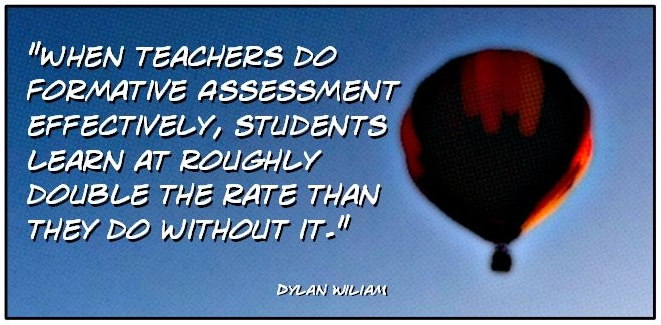
As important as we all know formative assessment can be, it can be tedious to keep coming up with worthwhile questions, in addition to lesson planning and grading.
How can it be Easy?
I can solve that problem for you!
We all know that we have enough on our plates without creating daily assessment questions. However, having the right questions can be really important to get the information that we want.
I have created full year bundles of warm ups for Biology and Earth Science. You can see the questions and preview them in more detail by clicking on the links.
The Biology set comes in both Google Slides and Google Forms (also includes directions to use in PDF format, or in other Learning Management Systems. The Earth Science Set is only available in Google Slides (with directions for PDF or other LMS; no Google Forms at this time).
Both include sets for each unit typically taught (13 units for Earth Science and 10 units for Biology), as well as a bonus set with some blank slides/forms, and general formative assessment questions that can be used anywhere you choose. Each set includes 16-18 slides/forms with generally 2-3 questions each. They are correlated with learning objectives (Biology and Earth Science), so that all objectives are covered. Answer keys are included. Many questions include diagrams, inferencing skills, etc. There are a range of questions difficulties and styles of questions, allowing you to differentiate for your students.
This is a topic that I have written about extensively, because I think it is so important. I also written about other ways that I use these digital task cards, and how and when I use formative assessment.
My top 5 most popular posts on these topics are here:
I hope this answers most of your formative assessment questions. If not, just comment an ask!!!I hope this answers most of your formative asses
Next time students are entering class you will be able to have a clear understanding of where they are and what they understand before you begin teaching. I can make that extremely simple for you pull off! Check out my full year bundles here.
I have been asked about how I organize my bellwork and warm-ups, both in terms of how I organize the papers and the class time. Some of the complaints that I've heard are against doing warm-ups are: too much grading, too much time being spent in class time, wasted for students to settle down, too much shuffling papers and more.
Grading
I have already addressed the grading in a couple of other posts here, here, here, and here.
Timing
As far as the class time I'm really a stickler for using a timer and keeping my bell work very short. I know some people do bell work that's a bit longer, it depends on the length of your class, and how you want to run your class time. I usually keep it to three to five minutes. My bell work is one two three questions. If it really seems that people are working and need an extra minute or two I make extend it.
I enforce that by using a timer that is visible on the Smartboard. Depending upon how you setup your bellwork there are stand-alone timers, internet timers, Smartboard timers, the 1-click timer Chrome extension and many others.
Paper Organization
As far as how to organize the papers I've done it a few ways. I like to keep all my bellwork questions for a one-unit together in either a Google slide presentation, PowerPoint, Smart Board file, etc. Then I have the students answer on a bellwork or warm up sheet link here. They turn this in each day. Before their class, I spread them out on either a back table, counter, or something like that. On their way in the students can grab the paper with their name on it. It's a little extra incentive for them to get to class early or at least on time because the timer starts when the bell rings.
Electronic Organization
When I have done bellwork electronically I have most often used a Google form. I share the link through Google classroom. They can quickly click on it answer, and all the answers come to me in one place. I can also turn the form off when the time is up, so that they have to submit in a timely fashion. I have also done a Google slide. In this case, I have all my warm ups in that slide file. I copy just today's slide. share it with them through Google classroom or through a force copy. They put their answers on it and then submit. Google Classroom really facilitates this very easily.
Class Time
As far as during class time I can usually make a quick assessment if I want to discuss bellwork or go over it based on what I see when students are working. If I use a Google form where I can get instant feedback then, I can pull the results up on the board and this can help me assess and decide if I want to have a class discussion. If I find out that I'm wrong it's perfectly okay to go back the next day.
What questions do you still have? Ask them here and I will do my best to answer!
When students are doing an assignment in Google Drive one of the difficulties maybe how to best get their scores and feedback to them. This is especially true if you are doing a series of smaller assignments, such as warm ups.
A few general ways
There are a few general ways to do this and I will give you some tips on each one.
Use a learning management system, such as Google Classroom (probably the easiest), Schoology or many others.
Give them feedback directly on the document using the comment tool
Create a spreadsheet or PDF document that lists grades by ID number. There are pros and cons of each of these of course.
In Google Classroom
In Google Classroom it can be pretty self explanatory to grade an assignment there, and give feedback. Then those grades will likely have to be entered into your gradebook, unless your school has a way of importing them.
Sharing a Single Slide and Giving Feedback
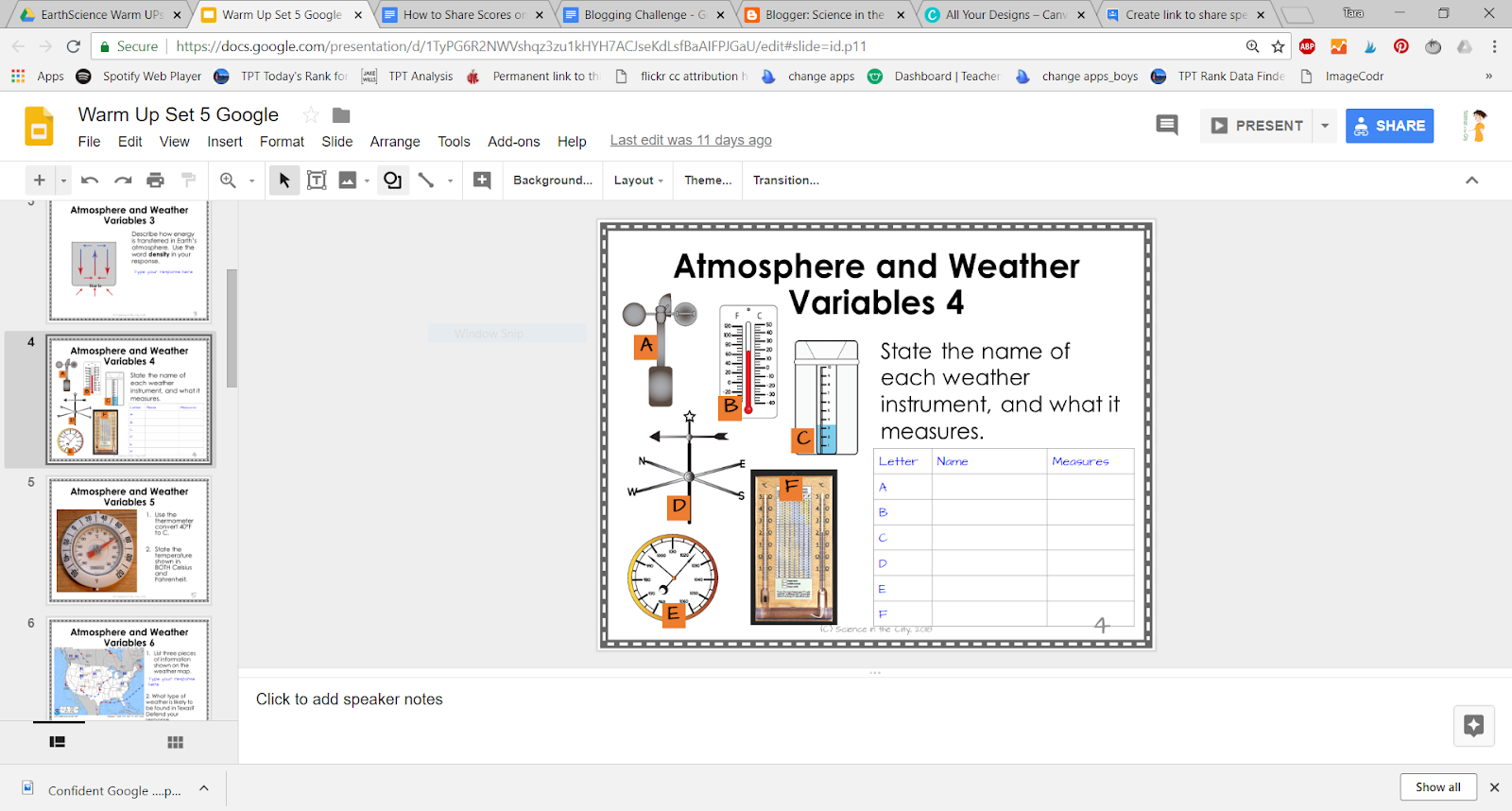
I have sets of warm-ups that are a set of Google slides that cover the whole unit. For example, here is a set that I have on weather.
If I want to share only one slide with a student that day, I would do the following steps:
Copy that slide to a new presentation
I would share with them through either Google Classroom, or by creating a force copy link.
You can see what the student sees by clicking here.
The student then can type directly into the slide, and then either submit through Google Classroom, or share back with me. For me to be able to comment, they must share with either ‘can comment’ or ‘can edit’
It then becomes very easy to comment on their work, from my computer. More information on using comments for student feedback is available here.
If I do it this way, I often keep a piece of scrap paper next to me to record their grades, or another window open to record grades as I go through, if I am not using Google Classroom.
Google Forms and a Spreadsheet
I discussed how I use Google Forms and create a spreadsheet by ID number in this post.
Other Tools and Tips
There are other tools as well, which I will touch on just briefly.
If you are often entering repetitive feedback, and want to have a bank of comments, feedback, and even stickers that you can use, take a look at this article on using Google Keep for Quick Student Feedback
If you (or your students) would find it helpful to give spoken feedback, look into the Kazienza app. It is a very simple Google Chrome app that enables verbal feedback.
Only in Google Docs (not Slides, etc), there are several tools for rubrics, which can also simplify the process of grading and giving feedback to students. This can also be done within Google Classroom. And lastly, one more Google Classroom rubric hack.
I hope that these tools help make your digital transition a bit easier, as you find more effective ways to manage your grading and give feedback to your students.
What do your students need to know and be able to do to be confident using Google Drive?
Benefits of Google Drive
Google Drive is a great tool and it's easy to use, but students need to be comfortable and confident for it to be successful. Students can store any file in Google Drive, access them anywhere, share with others, work saves automatically, and they can search for their work.
How to Best Prepare Your Students
However, to take advantage of these benefits, students need to be comfortable with Google Drive. What they need to know will really depend upon the assignment that you want them to do but some basic skills and facts that student should know include the following (I am including a link with a good summary to each):
Basic formatting tips -- the G Suite Learning Center is a great resource, even with printable PDF’s that would be great to put on tables, or hang around the room! I am linking here to the section on Docs.
How to make a forced copy (this can also be done through Google Classroom
It may help students if you make a template that they can fill in. This takes away a lot of the fear of staring at a blank document. You you could give the option of using a template. Some students will want to be creative but not all. I often make a template with a forced copy link as in #4. Another option is to make a template, as described here
Think about the specific assignment that you want them to do, and what skills will come in most handy.
When and how should I teach these?
I am not a big fan of doing a big intro, but a quick mini lesson, or even a few steps at the beginning of the assignment that will teach and review the necessary skills. These assignment specific skills might include things such as:
inserting pictures
formatting
inserting links
Be patient as students are learning new technology. We often think that they are ‘born with technology in their hands’ and that they already know all of this, but in many cases they do not. They may know some technology skills, but not necessarily the academic ones we are trying to teach them. Work with your students and you may learn something from them too.
I have written quite a bit already on how I use warm ups in my class, and how important I believe formative assessment is, for both the teacher and students. I also have several emails on the topic, so feel free to sign up for my email list, either by clicking here, or the sign up box on this page, if you haven’t already, to be sure you get those.
With these in mind, I am most of the way through creating a year long set of Earth Science formative assessment task cards. They can be really useful to you for a variety of reasons:
Google Slides to project on the board, if you want to have students record their answers on separate paper.
Interactive Google Slides so that students can type directly onto the slide, or move pieces around to answer the prompts.
Printable PDF’s so that they can be used as task cards.
Instructions are included to use with PowerPoint, and to use with several other digital platforms.
These have an emphasis on understanding diagrams and key vocabulary.
These work work well as daily warm-ups, tickets out, review activities, task cards, even an early finisher activity. Task cards have so many uses.
They are a full year set of 200 task cards, so you can use one every day, or pick and choose how you want to use them and have a big selection.
I don’t know about you, but it can be hard to consistently come up with questions. It is a huge time saver, and sanity saver to have a bank of questions ready to go. I hope these Earth Science Formative Assessments are helpful to you.
If you have specific questions, or suggestions, please feel free to comment or email me!
**This post was written by Science in the City, and previously posted on www.technologytoolsforteachers.com. However, that site has been discontinued, and so my content will gradually be posted here **
Tips for Successful Technology Sub Plans
We’ve all been there – you have to be out for a day, but its nerve-wracking. What to leave for a sub? How to make sure it goes smoothly? You don’t want to waste a day of class, and you don’t want to come back to chaos the next day. Especially at this time of year, there seem to be more field trips, family events, and reasons to be absent.
Here are my suggestions (granted I have mostly taught secondary, but I think these suggestions would work even with upper elementary as well).
You can’t always guarantee who you will get as a sub, or how your students will react, so here are a few suggestions to minimize the stress.
LEAVE THE DIRECTIONS DIRECTLY FOR YOUR STUDENTS
Students are used to receiving direction from you. They are more likely to give a sub a hard time, or the have confusion. Give the directions to the kids. If you use a learning management system such as Google Classroom, Schoology, Edmodo etc this is very easy. they are already used to logging in, and can look for their work there.
If not, I have left the kids a very quick and simple set of directions of what they are to do for the class period, and what is to be handed in at the end of class. I sometimes leave the kids direction in the form of an official looking ‘memo’ with the assignment for the day, when it is due, and what to do if they have extra time. I photocopy either for each student (even a half sheet is plenty), either as a separate handout, or as a cover page with today’s work that explains their directions for the day.
This leaves the sub free to either tell students to login and read the directions, or the pass out directions, as well as take attendance, monitor behavior, and deal with questions and problems, rather than try to teach/lead a lesson that he or she may not be comfortable with. It also takes out the middle man. I don’t know about you, but I have heard some strange stories such as “the sub told us not to hand that in” or the “sub never passed that out, etc”
LEAVE THE SUB PREPARED
Make sure the sub is prepared to do the things that you really need him or her to do. Here are some tips:
leave attendance rosters
leave a class schedule
leave a seating chart, if you use one
leave directions and contact information for another teacher to ask in case of questions
leave directions or a phone number to call for the main office/security in case of a problem
clear directions of what work should be handed in
leave some type of feedback form, this helps ensure that you will get feedback on how the day way. There are numerous free versions available by searching for substitute feedback form. Here is a good resource from the National Substitute Teachers Alliance.
HAVE A BACK UP PLAN
As has already been mentioned in many other places, it is important to have a back up plan.
My go to backup plan is either a news article summary or a vocabulary activity. I keep vocabulary lists, and a vocabulary menu of choice activities for students to practice key vocabulary. I also keep a bunch of news articles printed out, with a generic news article response template (I just use the first page). Even if you don’t keep articles, you may be able to get a few copies of the newspaper or of magazines from the school library. Again, there are numerous current events summaries available with a quick search, so I would recommend that you find one appropriate to your students.
These are assignments that students can do for extra credit or early finisher activities but they are also great for emergency sub plans, or if the technology isn’t working. Sometimes there is a sub who isn’t comfortable with the technology or has an issue getting kids logged in. These are a perfect temporary solution.
Whenever there is discussion of differentiation, or creating and using differentiated assignments, one of the biggest struggles that comes to my mind, and I think for many other teachers, is how to grade those assignments fairly (and hopefully without creating excessive work for the teacher).
It can be overwhelming to think about how to grade all these different assignments or how to make sure that students are fairly evaluated when they're given different assignments here are a few ideas:
First of all, keep in mind that in some cases differentiation is simply another way to learn the content, or practice with the content, and that it does not need to be graded separately. It is a different way to arrive at the same goal and only feedback or formative assessment may need to be given.
If you do decide to grade the differentiated assignment, here are a few suggestions:
You could create a checklist and then simply add or subtract a few items on that list from the differentiated assignment.
Create a rubric so that whichever format of an assignment students are doing they need to meet the same general criteria but they might meet it in different ways. The rubric should be focused on the content and the goals of the assignment, not the format. Here is an example of that. Along with rubrics, here is a more in-depth discussion of something called the “slide rubric” which allows students to show growth, and to show more differences between levels on the rubric. It would take a bit of work to set up, but be easy to score when finished.
The differentiation may be scaffolding that is provided within the assignment, in order to reach the same goal. So, it may not be visible in the final grading. The final assignment that is turned in may be the same, but it may have some scaffolding built in.
If it's a small assignment, you might want to consider giving a check, or a completion grade for partially complete, incomplete, or not done scale, given whatever their assignment directions were.
Assessment could also focus on progress monitoring, such as showing growth, depending upon the needs of your classroom. I think elementary classrooms do a much better job at this than secondary. We have a lot to learn from them!!
As you are thinking about this, remember that
Grading should ultimately reflect the standards so you're grading should come back to what are the key points that students need to know did they demonstrate their understanding?? Maybe they demonstrated them in different ways but if they sufficiently demonstrated that they know the material that should be the focus of their grading. In other words, the grading is tied to the content of the project, not the format of the project. This is discussed further in this webpage (a very thorough look at differentiation, with a discussion of grading).
If you are using technology, Google Classroom has great options for differentiation as well, that you should be aware of! This article doesn’t specifically address grading, although it touches on it, but it is a great description of using Google Classroom to differentiate, and may give you some great ideas!
As far as a more theoretical perspective, here is a great slideshow from Carol Tomlinson (Differentiation Guru) on grading. She outlines 6 principles on grading that absolutely apply to grading differentiated work as well, and help put things in perspective.
How have you differentiated and graded those differentiated assignments in your classroom? I would love if you would share your experience and your ideas with us either in the comments here, or in our Facebook group.
My Students Know the Content -- Why Do They Test So Poorly?
You may have been taught and prepared to teach your students the content. You have spent time doing that, and you think they understand. Then you give them standardized test questions and they bomb, they shut down, or they keep calling you over very confused. How can this be? You thought you taught them this information?
Sometimes it's not the content words that students are struggling with, but instead it's the non-content vocabulary or the Tier 2 vocabulary. In other words, they know the content but they don't understand the questions or they don't understand the reading passage. If they don't really understand what they are being asked, they can't begin to answer the question.
So many of our students don't have the background knowledge and vocabulary, they may be ELL students or they may just not have a lot of academic vocabulary.
So what can we do about this?
We need to teach our students this vocabulary! And to successfully teach vocabulary students need practice with those words in several different ways. Of course, this seem like an overwhelming task try to bring our students up to grade level with their vocabulary during science class or another content class but it doesn't have to be as difficult as it sounds. I have written about this before, but I was asked for more specifics on how I implement that strategies and vocabulary that I use.
Here is what I have done
Here is what I did to work on tackling that problem and I'm hoping it will help you too. I went through our last couple years of State exams as well as a few other resources and I compiled a list of Tier 2 vocabulary words. I also asked my students, as we did practice questions throughout the year, what words they didn't know or were confusing and added to the list. I also shared resources with a few other teachers. At that point I had a very good list of words.
I use those first for warm ups. Here are the basic steps that I follow:
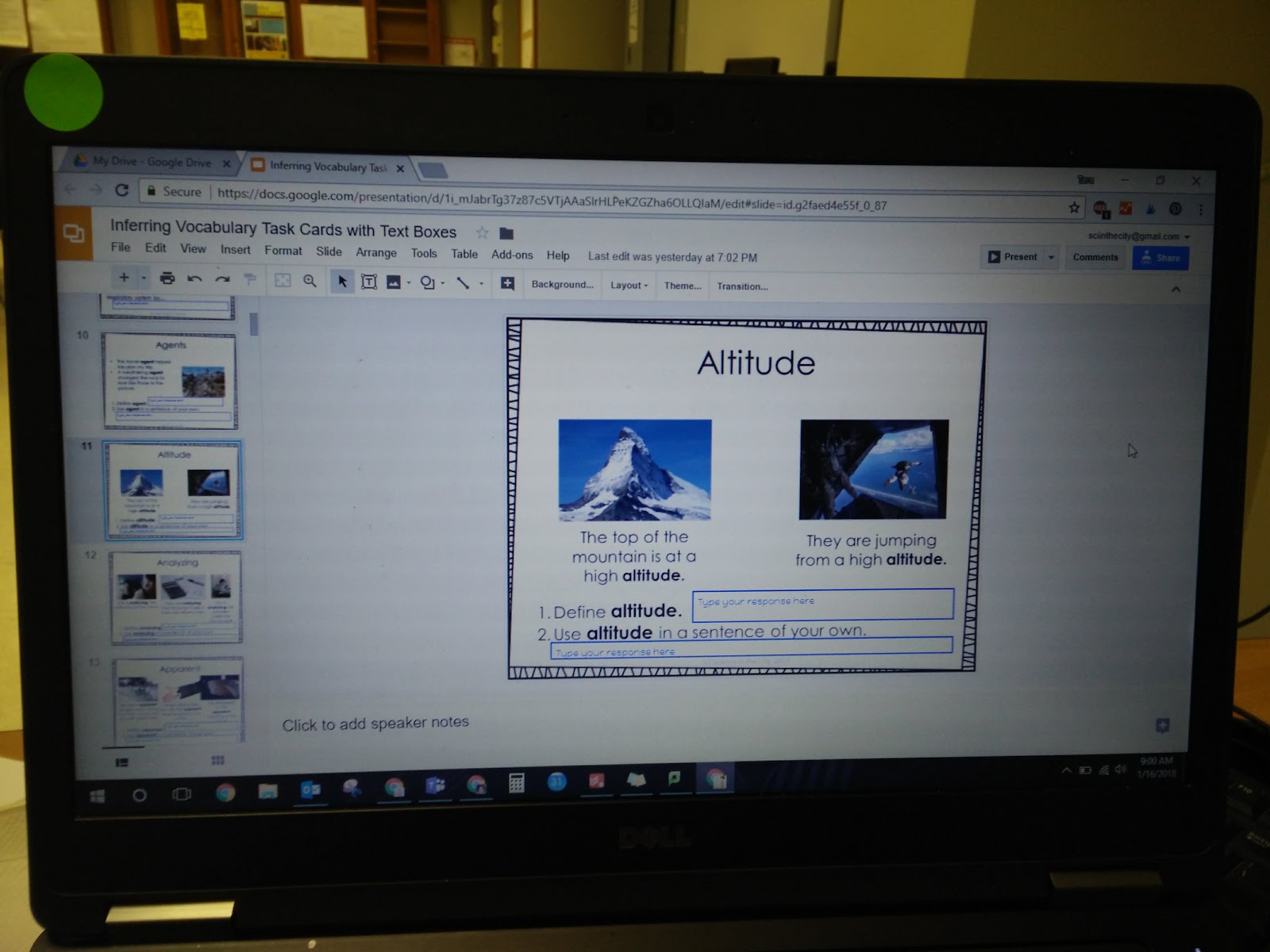
I took a word a day, usually, and I gave them a sentence or a picture to infer, or comparison to another word.
Then I had them try to conceptualize and infer what they thought the definition of the word was.
I would usually project these on the board, and have students record their answers. This could, of course, be done in a Google Form, slide, on paper, or many other formats that fit with your classroom routines. This did two things at once: (1) they got to practice the skill of inferencing and using context clues to figure out the meaning of a word that they didn't know, (2) they also started to get familiar with some of these words.
I would usually do one word a day so five words a week and then after the end of the week or at the end of 2 weeks we would have a little quiz on those words. Sometimes it would just be a matching quiz, sometimes question that had one of those or a reading passage that had one of those words so they could see it in context.
After awhile, it was amazing, students started to learn some of the words but more importantly they started to gain confidence. When we do test questions where they would run across those words I would start to hear things like “Oh, I know this word!” “This is a word we just did last week.” They were not longer foreign, but were familiar instead. Even if they didn’t remember all the definitions, the vocabulary had lost its power to be scary!
What's the Next Step
It's so important that these are integrated in throughout the year and the students practice using them so that it's not an isolated thing. To facilitate this, when we did stations for other topics (I do a lot of stations in my classroom) I usually throw in one extra station to focus on those vocabulary words. It might be the same thing as what is on the board, as a review, but a few task cards printed out. It could be matching up words and definitions either on paper or on Quizlet. Sometimes the station would focus on vocabulary more subtly because it would ask them to write a test question using some of those words (maybe with a word bank or sentence stems). It's so important that they see these over and over again so that they lose their fear and mystery.
This is something that you could easily implement on your own but if you would like to make it easy, my complete set of over 200 words (more than enough to use one every day) they're available here
Here are a few of the pieces of feedback I have gotten on this resource. I hope it can be helpful to you as well!
I also wrote more about this strategy in these other posts, here, here, here, here, and here.
We have all been there. We are supposed to teach students to meet the same standards, but we definitely do NOT have 25 of the same students sitting in front of us! How do you meet these varied needs within one class? You may have student reading at a huge range of grade levels, or students with a wide range of disabilities, and capabilities, or even students for whom English is not their native language. This is where differentiation comes in! Differentiation can be overwhelming, but it doesn’t have to be so overwhelming. You can make some small changes that can have a large impact on your students, and technology can help make that a lot easier for you.
As we probably are already aware, there are many different ways to differentiate. Differentiation is commonly broken down by process, product or content. For any of these methods, technology can be a great tool for differentiation. Here is good basic overview of the three types of differentiation, if this is new for you, or you want a quick refresher. I am not going to rehash all of that, but instead I will seek to give you some tips on how technology can help you differentiation.
Differentiation by Content
Differentiation by content refers to different ways that students could get the content, or perhaps even slightly different content. What students are learning may be different. Some students may get the material through reading, watching a video, small group instructions, or even different videos, or different reading levels. Students could even read text off of a screen, but use a screen reading chrome extensions so that the text is read to them.
Look into Newsela or readworks for levelled reading materials, and videos already discussed such as Bozeman Science, Khan Academy, Amoeba Sisters, Crash Course, and many others for content at the appropriate level.
This is a place to play around with a flipped classroom idea, and create an instructional video, even if students watch it in class. It allows them to watch and replay, take notes, while you work with other students, and maybe a third group of students reads about it. You can, essentially, be in more than one place at the same time.
This can be done by choice, or with different content sources assigned to them. Google Classroom makes it very easy to assign different content sources to different students.
For additional information, here are some great step-by-step directions for using Google Classroom to differentiate.
Differentiation by process is all about what the students do to process the information, or HOW they get the content. Differentiation by process can certainly overlap with content differentiation, as students may work through the content using one of these processes (think-pair-share, reflection, diagram labeling, etc). Content differentiation is the content itself. Process differentiation is how students take in the content, or what they do with it to process it. For example, even as students are taking in content, they can use screen reader extensions to read the text, use dictionary or translation tools to help understand the text.
Process differentiation means you may give an assignment with some options. Perhaps some students can work in a group, and other can work alone. Students can choose to use technology, or to do their assignment on paper. Students need a way to process the material, but there are many ways that this can be accomplished. Students can process their learning through drawing, writing, making a video, using a technology such a flip grid, talking with a partner and more. Some students may be helped by a video that they can pause, rewind, re-watch, and use closed captioning.
These methods may need to be taught, or alternated/cycled between, and then eventually students could perhaps have a choice. Another strategy would be to give students a choice between just two methods, and then gradually introduce other methods.
The Science Penguin has a great post on “Output Ideas.” Although these are designed to be on paper, it is not a leap to see how these could be differentiated even more easily with technology. Students could make a short recording, find a diagram and label it, type their response and more.
Lastly, differentiation by product is probably the type of differentiation with which we are most familiar, where student create a product to demonstrate their learning and are given some type of menu, or choice. A very simple example is this Vocabulary Menu where students have a choice over what the turn in to demonstrate their understanding of the vocabulary terms.
This is also a great place to look at the post on 4 Technology Rich Ways for Students to Demonstrate Knowledge. Technology gives more options. Are you artistic? Make a poster. Not artistic? Make an infographic or slideshow, where you don’t have to draw. Would you rather write? Or speak? Write an essay or editorial, or make a podcast or video.
Just like in the regular class, without technology, differentiation is key to helping your students be engaged and feel successful. The methods to differentiate may be similar, but it is easier in some ways to make changes to the assignments and to have the changes be less visible (such as through the use of screen reader apps, or Google Classroom to distribute differentiated assignments to different students). There is less stigma attached. Also, technology helps create a classroom culture where students are more independent learners, learning in their own way. This is a great fit for differentiated instruction. Using technology means you can use the tools available to you to help create modifications, or create additional instruction. You don't have to create it all!
Easy Bite Size Steps to Increase Classroom Technology
If your school has just recently gone 1:1, or just announced that they will be going 1:1, hopefully I can help. This is part 2 in a short series to help you transition to 1:1 technology.
This post will assume that you have gotten some of the procedural details and routines out of the way that were discussed in Part 1. Now you are looking for some ways to transition into using more technology in your classroom.
Ten Small Steps to Start Using Your New 1:1 Technology
A video station - There are huge advantages to having students watch at their own pace, and be able to rewind, pause, or replay as needed. Here is a good discussion of using videos in the classroom. One of my favorite strategies is to have the students watch at a station, with a partner, and do a strategy that I call “watch, talk, write.” Students watch a short video with a partner. Talk about it with their partner. Then they write a short summary, often of a specified number of sentences, where they have to decide what information to include.
A vocabulary station with Quizlet - Quizlet is a great site for students to review vocabulary, or really anything that needs to be memorized. You can even add in diagrams with labels where students can quiz themselves. This could be an early finisher activity, a station, or a whole class activity.
Review games using Kahoot - Kahoot is a great way to do review. It can only be used for multiple choice or objective questions, but students get so engaged! Its quick and easy to set up, and students love it.
Formative Assessment - My favorite formative assessment tool is Google Forms, but there are many others out there as well (Socrative, Plickers, and many more). I have written about Google Forms a few times before, here, and here, and a bit about Plickers here.
A virtual field trip or interactive website. Here is a great start on places to look for interactive
Resources for kids to use when they finish early - Having technology in your room gives more options for differentiation, in a lot of ways. However, one great tool is the ability to have more websites available for early finishers for review, enrichment, or reinforcement. Quizlet is great, various websites with science news articles, or, depending on your state, practice exam questions.
Change an assignment to a Google Doc - Google Docs have a lot of advantages, they can be accessed anywhere, they save automatically, and they can be shared. It is fairly easy to upload an existing assignment and convert to a Google Doc, making a copy for each student, or distributing through Google Classroom.
Video instructions of a lab or of a lab demonstration - If you are doing a demonstration, or giving instructions of how to do a lab, it can be extremely helpful to video this. Students can rewind and pause, students who are absent can watch, and somehow they even seem to pay closer attention to a video than to the teacher! This video can be uploaded privately to YouTube, or to Google Drive and shared with students as needed, or posted in Google Classroom.
Background research or vocabulary research going into an activity - before beginning a unit or an activity, we all know that students need to build background knowledge. As they are all coming from different places, and starting with different amounts of background knowledge, it can work well for them to research vocabulary terms, or a specific topic for background knowledge on their own, before diving into the instructional part of the unit.
I hope this helped you consider some ways to start using technology in your 1:1 classroom! It can be overwhelming, but don’t get overwhelmed. Take it one step at a time, and don’t be afraid to try something.
Questions? Ideas? Suggestions? Please comment below or join me in the Facebook group.
My School Just Announced We Will Be 1:1 Where Do I Begin?!
School Expectations
First of all, don't panic! Spend some time finding out what the school expectations and rules about 1:1 devices are, how was the devices will be assigned, where will they be stored and what training is provided. Also think about how often will you be expected to use them, or how often you want to use them? What school policies may be in place around students carrying them between classes, or bringing them home? What is the devices aren’t charged? What will the behavior policies be for students who are on other websites? Some of these questions may not have quick and easy answers but they are important to start thinking about, as you begin framing how you want to use technology in your classroom.
Technology is a Tool
Don’t get overwhelmed, but realize that the technology is a tool just like any other tool. It is there to help you and your students. Using technology could completely transform the way that you teach but there are lots of small steps for you to start with as well. Using technology in your classroom doesn't have to be an overnight dramatic shift.
Procedures and Skills
As you get started make sure you allow some time to teach procedures and teach technology skills. Even though we think students grew up with technology, and that they know a lot about technology, it often turns out that they don't know how to use technology for academic purposes. They may know how to use it for YouTube or other ways, or know how to do things on their phones, but may not know how to do some of the tasks that we ask them.
Some procedures and introductory lessons that you may want to cover in your classroom if they are not taught in school as a whole include: digital citizenship, procedures for carrying a Chromebook or laptop, where they will be stored, charging procedures, what to do if a student's technology is not working or is missing that day. What classroom rituals and routines do you want to set up around the devices. Some teachers have students put in only one earbud, close the lid of the laptop or chromebook, or put tablets face down when the teacher is speaking, etc. What will be the consequences if a student doesn't follow the technology directions? If you take the device away do you have an alternative assignment? If it WiFi is down or technology is unavailable do you have an alternate emergency assignment? These are things to think about and to try to clarify in your head as you begin to picture your classroom with technology. These are not meant to scare you off but to prevent future problems.
How Do you Want to Use Technology
Once you have some of those procedural things out of the way, start thinking about how and when you want to start to build in technology into your classroom. Do you want to use them at the start of class everyday? At the end of class everyday? (There are a lot of great ways to do formative assessment or warm ups using Google Forms). Do you plan to use them only as needed for certain interactive activities or stations? Especially for science, there are a lot of good videos (BrainPop, CrashCourse, Bozeman Science, Amoeba Sisters) and interactive virtual labs and field trips to use for particular topics). You could also look into Digital Interactive Notebooks, but probably not as a first step.
Using technology in the classroom really provides a lot of opportunities to engage students, to individualize instruction, to free up your time to work with students rather than being at the front of the room and for students to connect with others outside of the classroom walls.
My advice would be to jump in and get started. Emphasize to the students that you are learning along with them, and take it one step at a time.
Inspirational Ideas and Resources
Just for inspiration, here are a few of my favorite resources for technology in education happening very differently through technology!
Don’t get overwhelmed by learning the tech tool. You can do that with a bit of training or some searching of online tutorials/videos. Instead, spend your time thinking about how you want your technology-infused classroom to look. What will it look like in the long-run? What smaller steps can you take now to go toward that goal? Maybe each marking period you can add on to that? Or maybe take one unit and re-vamp it, but leave your others for now.
What are your 1:1 technology questions and concerns? Leave your questions below or in our Facebook group, but don’t be afraid. Give it a try!
4 Technology-Rich Ways for Students to Demonstrate Their Knowledge
Many times we asked students to do class work in such a traditional manner, such as to write a research paper, write an essay to present their knowledge, in written form only. While it is important that students can read and write, This is not the only way for them to show their knowledge. It's important to give an element of choice as well as to give variety throughout the year so that students who excel in other areas, or who struggle with writing have a chance to show their knowledge.
Why not just write an essay?
Perhaps that particular student is not a strong writer, but really does know the content. Or may they are really good at animation, graphic design, sound effects, or some other aspect. It's time that their knowledge show through. Some great ways for them to demonstrate their knowledge, other than written expression would be a screencast, Thinglink, a PowerPoint or Google Slide presentation, a podcast, or even an animation such as PowToon. Sometimes, even if the student is a stronger writer, having an aspect of choice is so important. Allowing the student more choice over how to demonstrate their knowledge is a way to get more buy-in and engagement from him or her, and more excitement about the assignment.
Podcast
A podcast is a very easy alternative to implement, and has many different applications in the classroom. Students could simply do a voice recording on a tablet, phone, computer with a microphone, or many other devices. If you actually want it to be posted as a podcast available online, this is possible too, and there are a lot of tutorials and guides online. However, for a single assignment, it would be appropriate for students to just make a recording, and it could even be shared as an audio file on Google Drive, if you choose. The downside of this is it of course you can't include any visual elements but for some students and some topics this will be enough.
Screencast
A screencast is a recording of the computer screen it can be done with a camera with it, showing the student's face, or without and can record only the tab or the desktop of the computer, along with recording audio. This is a very simple way to record a short presentation with narration, a technology skill, or student presenting or showing a particular topic or skill. There are lots of ways to do a screen test but my personal favorite is the Chrome extension screencastify I believe you can make a free recording up to 10 minutes and the results is saved right in Google Drive. Very simple!!
Thinglink
Thinglink is a paid product, but there are also free accounts with a few limitations. Thinglink allows the student to start with a picture such as a map, photograph, diagram, etc and then add certain buttons with information and links, videos, sound files, or even text documents and callout buttons to make a multi-media clickable image. Again, this depends on the topic, and how it is best suited. I think this would be great for presentations where you want to show a lot of information from different sources. A word of caution, be careful that the student is able to summarize their information, or paraphrase and cite the information, because it can be very easy to just cut and paste a lot of information. Thinglink is a great way to make a really different kind of presentation and include various kinds of information. Here is a great example of a human body presentation.
Powtoon
Powtoon will allow students to create an animation. They write the script, and record the audio, and then choose different backgrounds, characters, and what they will say. Here is an elementary example
Powtoon can be a lot of fun and very interactive for the students. It is quite different than what they may have done before. The warning on this one is that there will be a bit of a learning curve for students. It may take some time for them to get comfortable, so allow extra time to learn the technology if you choose this method.
Lastly, don’t rule out a PowerPoint or Google slide presentation. This is not really a brand new method, but can be an alternative to a written presentation. Both allow shorter, more broken up writing, and the insertion of videos, images, and other multimedia formats into the presentation. Google Slides is easier to insert videos and easier to share the final presentation. PowerPoint is easier to insert narration or sound files if this is something that you want students to do. Adding audio to Google Slides is difficult.
As we transition to using more technology, under the SAMR model, these may be some ways to push your teaching, and your students learning, to the next level, and to further engage your students. Have you used any of these in your classroom? What other alternatives do you utilize, besides a written essay, do you use for students to demonstrate knowledge? Please share in the comments.